The Cambridge Companion to the Classic Russian Novel by Malcolm V. Jones
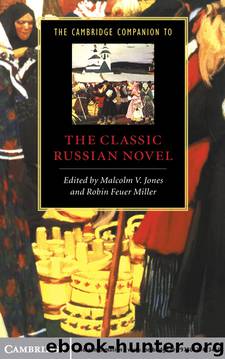
Author:Malcolm V. Jones [Malcolm V. Jones and Robin Feuer Miller]
Language: eng
Format: epub
ISBN: 9780521473460
Publisher: Cambridge University Press
No class in Russian history has had a more momentous impact on the destinies of that nation or indeed of the modern world than the intelligentsia.
(Martin Malia)
We get the word “intelligentsia” from Russia, where it came into circulation around 1860. Virtually all commentators have noted that the Russian term did not mean the same thing as its English counterpart (or, for that matter, as the Soviet use of the term). The word is very difficult to define because it was used in various ways, because it changed its meaning somewhat from decade to decade, and, most importantly, because it had honorific overtones: debates on Russia’s destiny often took the form of redefining the “true” intelligent. Nevertheless, there was a group that almost everyone would have acknowledged as intelligenty in the strict sense, and it was this group that most offended the great writers.
One might readily identify three characteristics of the intelligentsia in this sense. First, an intelligent was expected to identify above all as an intelligent. To be an intelligent was not like being an Anglophile, a general, or a poet, all of which were compatible with a primary identity as a nobleman. Whereas an English intellectual might be a nobleman or professional who happened to be interested in the arts, a Russian intelligent owed his first loyalty, indeed the very sense of who he or she was, to the intelligentsia. A profession was to be pursued simply to make a living, and was to be abandoned whenever the (usually revolutionary) demands of the intelligentsia required. That is the point behind the comment made about Kirillov in The Devils: is it wise to hire an engineer who believes in universal destruction?
Second, an intelligent was expected to adhere to a particular set of beliefs. From this expectation derived an extreme intellectual conformity and a willingness to slander anyone who disagreed, characteristics that especially offended the major literary figures. Required beliefs differed over time, but they always included a commitment to socialism, atheism, and revolution. Most important of all, they involved a faith that the intelligentsia itself was destined to save society and that others could and might be sacrificed to realize its theories and dreams. “I am beginning to love mankind à la Marat,” Belinskii had declared; “to make the least part of it happy I believe I could destroy the rest of it with fire and sword.”6 Nechaev and the terrorists of the 1870s also viewed their contemporaries and people from other groups as so much raw material to be expended in making a revolution, a perspective taken for granted by Lenin and severely criticized in Landmarks. Dostoevskii precisely caught the importance of the intelligentsia’s belief in itself when he had Raskolnikov divide humanity into a few extraordinary people who have the right to kill and the many ordinary people who serve as mere breeders. Raskolnikov comes to realize that none of his theories for saving humanity really matters to him; what matters is membership of the extraordinary. The intelligentsia’s
Download
This site does not store any files on its server. We only index and link to content provided by other sites. Please contact the content providers to delete copyright contents if any and email us, we'll remove relevant links or contents immediately.
4 3 2 1: A Novel by Paul Auster(12352)
The handmaid's tale by Margaret Atwood(7726)
Giovanni's Room by James Baldwin(7297)
Asking the Right Questions: A Guide to Critical Thinking by M. Neil Browne & Stuart M. Keeley(5734)
Big Magic: Creative Living Beyond Fear by Elizabeth Gilbert(5721)
Ego Is the Enemy by Ryan Holiday(5386)
The Body: A Guide for Occupants by Bill Bryson(5064)
On Writing A Memoir of the Craft by Stephen King(4909)
Ken Follett - World without end by Ken Follett(4703)
Adulting by Kelly Williams Brown(4549)
Bluets by Maggie Nelson(4533)
Eat That Frog! by Brian Tracy(4497)
Guilty Pleasures by Laurell K Hamilton(4417)
The Poetry of Pablo Neruda by Pablo Neruda(4078)
Alive: The Story of the Andes Survivors by Piers Paul Read(4009)
White Noise - A Novel by Don DeLillo(3987)
Fingerprints of the Gods by Graham Hancock(3974)
The Book of Joy by Dalai Lama(3958)
The Bookshop by Penelope Fitzgerald(3826)
